.jpeg)
First Time Filing Taxes in Canada: A Beginner’s Roadmap
Key Highlights
- Your residency status is the most important factor in determining your income tax obligations in Canada.
- Filing a tax return is necessary to receive important government benefits and credits, even with little or no income.
- You must have a Social Insurance Number (SIN) to file your taxes and receive payments from the Canada Revenue Agency (CRA).
- You are required to report your worldwide income earned after & before the date you became a resident of Canada.
- Key deadlines for your tax return are April 30 for most individuals and June 15 for self-employed filers.
Introduction
Welcome to Canada! Getting used to a new country involves many new steps, and understanding the Canadian tax system is a big one.
Filing taxes for the first time can seem complicated, but it's an essential part of your new life.
Your first tax return is key to staying compliant and unlocking valuable government benefits.
This guide will walk you through everything you need to know about the tax year, your residency status, and how to file your return with confidence.

Understanding Your Tax Obligations as a Newcomer to Canada
As a newcomer, one of your first responsibilities is to understand your tax obligations.
If you are considered a resident of Canada for income tax purposes, you will need to interact with the Canada Revenue Agency (CRA), the federal body that manages taxes.
Your specific tax situation depends on when you arrived and the ties you have to the country.
Even if you don't owe any tax, filing a return is crucial for accessing benefits. But what documents do I need to file my first tax return as a new immigrant in Canada?
The following sections will break down who needs to file, how your residency status impacts your return, and the role of the CRA.
Who Must File a CRA Tax Return in Canada for the First Time
You generally need to file an income tax return if you have to pay tax for the year or if the Canada Revenue Agency (CRA) sends you a request.
This applies if your residency status makes you a resident of Canada for tax purposes, which often begins the day you arrive.
What if you didn't earn any income during the tax year? It is still mandatory to file your first tax return.
Filing is how you apply for important benefits like the GST/HST credit and the Canada Child Benefit.
Your specific tax obligations are determined by your unique situation.
Filing a return ensures you comply with Canadian tax law and don't miss out on financial support available to you and your family.
Securing a Social Insurance Number is a critical first step, as you will need it to complete your return.
Residency Status and Its Impact on Your Tax Filing
Your residency status is the single most important factor for your Canadian taxes.
For income tax purposes, you become a resident of Canada when you establish significant residential ties.
This isn't about your immigration status; it's about connections like having a home, a spouse, or dependents in Canada.
This status usually starts the day you arrive to live here.
If you are unsure about your status, you can complete Form NR74, "Determination of Residency Status (Entering Canada)."
The CRA will review your details and give you an official opinion, which provides clarity for your tax filing.
A temporary resident, such as a visitor or student here for less than 183 days without significant ties, may have different obligations.
If you arrived partway through the year, you are considered a resident from your date of entry.
This means you must report all worldwide income earned from that date until December 31 on your Canadian tax return.
Income earned before your arrival is not taxed by Canada but must still be declared to calculate your eligible credits.
The Role of the Canada Revenue Agency (CRA) for New Immigrants
The Canada Revenue Agency (CRA) is the government body that administers the Canadian tax system.
As a new immigrant, the CRA is your main point of contact for all federal tax matters.
They process your tax return, ensure tax laws are applied correctly, and manage the government programs and benefits you can access by filing.
After you file your return, the CRA will send you a Notice of Assessment (NOA).
This is a crucial document that summarizes your tax information, shows if you have a refund or owe money, and confirms your return has been processed.
You'll need your NOA for future financial applications, like getting a loan.
The CRA provides extensive tax information and forms on its website to help you understand your tax obligations.
You can also hire a professional tax expert for personalized guidance.
Essential Documents Needed for Your First Canadian Tax Return
Having your paperwork in order makes filing your first tax return much simpler.
Before you start, you'll need to gather several key items for personal identification and to report your finances correctly.
These include your Social Insurance Number, immigration papers confirming your arrival date, and all your income records from the year.
As you prepare, you may wonder, "What documents do I need to file my first tax return as a new immigrant in Canada?"
From your SIN to various tax slips and expense receipts, the next sections will cover every essential piece of paper you’ll need.
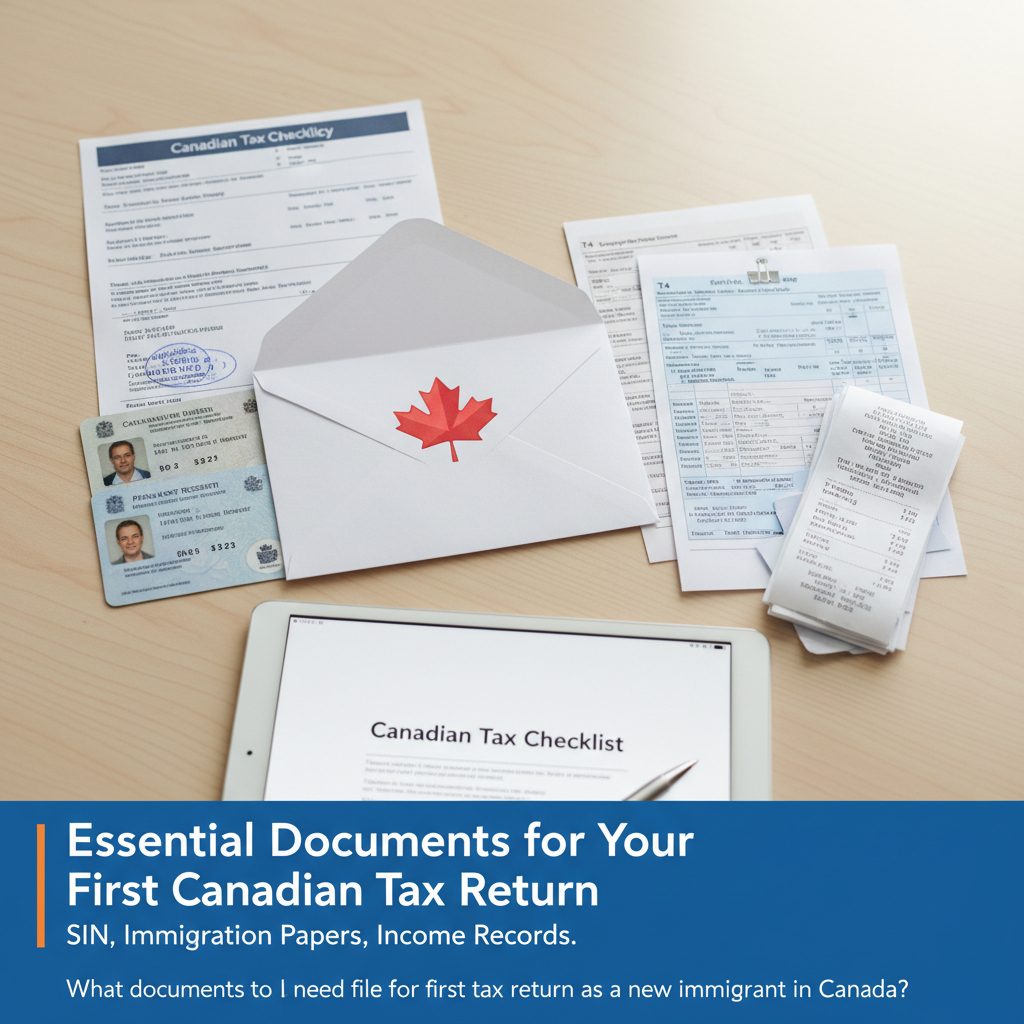
Social Insurance Number (SIN Number Tax Filing) and Personal Identification
A Social Insurance Number (SIN) is absolutely essential for filing your income tax return in Canada.
You need this nine-digit number to work in Canada and to access government benefits and programs.
If you are new to the country, you must apply for a SIN through Service Canada. It serves as your primary identifier for all tax-related matters.
Do you need a Social Insurance Number to file taxes in Canada?
Yes, you do. It's used to track your income, tax credits, and benefits.
Temporary residents will receive a SIN that starts with the number "9," which is linked to their permit.
If you find yourself in a situation where you need to file taxes but do not yet have a SIN, the Canada Revenue Agency (CRA) can issue a temporary tax number.
This ensures you can remain compliant with your tax obligations while you sort out your personal identification.
Income Records: T4, T5, and Foreign Income Statements
To complete your income tax return, you must report all sources of income you earned after becoming a resident.
This includes both Canadian income and any foreign income. For employment income earned in Canada, your employer will give you a T4 slip by the end of February.
This slip details your earnings and any deductions made.
You might receive other tax slips depending on your financial activities. A T5 slip is for investment income, while a T3 slip details income from a trust.
If you paid for school, you'll get a T2202 slip for tuition and education expenses. It's important to collect all these slips before you begin filing.
Remember to also gather records of any worldwide income you earned after your arrival.
This could be from a job, business, or investments located outside of Canada.
Having clear records for every type of income ensures your tax return is accurate and complete.
Expense Receipts for Credits and Deductions
One of the best reasons to file your taxes is to claim credits and deductions that can lower the amount of tax you owe or result in a refund.
To do this, you must keep all your receipts for eligible expenses. These documents are your proof if the CRA asks for them.
Are there any tax benefits or credits available to new immigrants in Canada?
Yes, many! Filing your taxes allows you to access valuable government benefits.
For example, you can claim tuition credits if you paid for post-secondary education.
You can also claim a deduction for eligible childcare and medical expenses that weren't covered by insurance.
By filing, you also automatically apply for certain credit payments, like the GST/HST credit, which helps offset the sales tax you pay.
Keeping organized records of your expenses is key to maximizing your return and ensuring you receive all the benefits you're entitled to.
Key Dates and Deadlines for First-Time Tax Filers in Canada
Meeting your tax filing deadlines is essential to avoid penalties and interest charges on any amount you owe.
In Canada, the tax year follows the calendar year, running from January 1 to December 31.
The main tax season happens the following spring, when you must file your return with the Canada Revenue Agency.
So, what is the deadline for new immigrants to file their first Canadian tax return? Knowing these key dates will help you stay on track.
The next sections will detail the specific filing deadlines, the consequences of missing them, and how to time your filing if you arrived in Canada partway through the year.
CRA Tax Return Canada Filing Deadlines for Individuals and Self-Employed
For most individuals, the tax filing deadline to submit your income tax return for the previous calendar year is April 30. For example, your tax return for the 2024 tax year is due by April 30, 2025. This date is crucial to remember.
If you or your spouse are self-employed, you have a later deadline of June 15 to file your return.
However, it's important to note that even if you are self-employed, any tax payment you owe is still due by the April 30 deadline. Paying on time helps you avoid interest.
Here is a simple breakdown of the key deadlines:
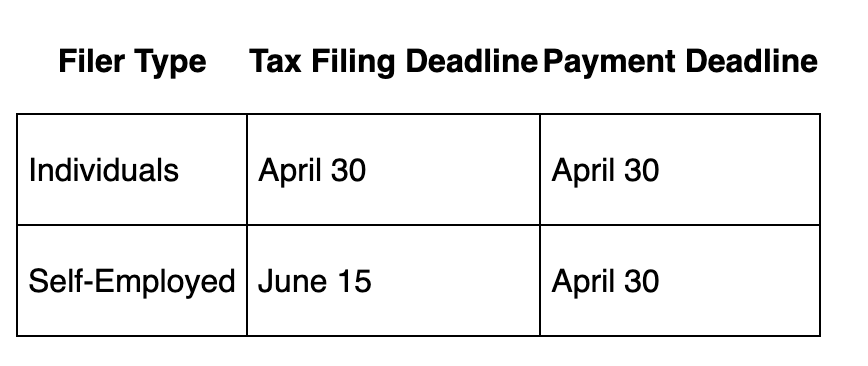
If a deadline falls on a weekend or public holiday, the Canada Revenue Agency considers it on time if they receive it by the next business day.
Consequences of Missing the Tax Filing Deadline
Filing your tax return late can lead to unwanted consequences, especially if you owe money.
The Canada Revenue Agency (CRA) charges a late-filing penalty if you file after the deadline and have a balance owing.
This penalty is 5% of your balance due, plus an additional 1% for each full month your return is late, up to a maximum of 12 months.
On top of penalties, the CRA will also charge interest charges on any unpaid taxes.
These interest charges start accumulating the day after the payment deadline and continue until the balance is paid in full.
Another key consequence of filing late is a delay in receiving your tax refund and benefit payments.
You must file a return to receive these payments, and you will not get your Notice of Assessment until your return is processed.
This important document confirms your filing and is needed for many financial activities.
Timing Your Tax Filing if You Arrived Partway Through the Year
Arriving in Canada part of the year creates a unique tax situation. For tax purposes, you are considered a resident of Canada from your date of entry.
This means you will file your first Canadian tax return for the tax year in which you arrived, but only for the portion of the year you were a resident.
For instance, if you moved to Canada in July 2024, you would file a return for the 2024 tax year by the April 2025 deadline.
On this return, you would report all income you earned from both Canadian and foreign sources between your arrival date and December 31, 2024.
Income earned before you became a resident is not subject to Canadian tax. However, the Canadian tax system requires you to declare this income on your return.
The government uses this information to correctly calculate any tax credits and benefits you are eligible for, so it's important to report it accurately.
Taxable Income and Reporting Requirements for New Immigrants
Canada's tax system requires residents to report their worldwide income.
This means any money you earned after becoming a resident, whether it's Canadian income or from another country, must be included on your tax return.
This might be a new concept, but it is a fundamental part of filing taxes here.
So, what income do I have to report on my first Canadian tax return as a newcomer?
You must also consider any foreign assets you own and how to report any potential capital gains.
The following sections will explain what counts as income, how to declare overseas assets, and what you need to know about tax treaty rules.

What Income to Report on Your First Canadian Tax Return
When you file your first Canadian income tax return as a resident, you must report all income earned after your arrival date.
This includes a wide variety of earnings from both inside and outside of Canada. For income tax purposes, it is crucial to account for every source to ensure your return is accurate.
Common examples of income you need to report include Canadian income from a job (employment income), income from a business, and investment income such as interest, dividends, or capital gains.
It is your responsibility to gather statements and slips for all these earnings.
In some cases, a tax treaty between Canada and another country may affect how your income is taxed.
Even if certain income is exempt, you must still report it on your return and then claim a deduction for the exempt portion.
Being thorough ensures you meet your tax obligations correctly.
Declaring Foreign Income and Assets Correctly
In addition to reporting foreign income, you might also need to declare your foreign assets.
If the total value of your specified foreign property was more than CAD $100,000 at any point during the year, you must file Form T1135, the Foreign Income Verification Statement.
This applies to assets like foreign bank accounts, stocks, and real estate outside of Canada.
It is also very important to determine the fair market value of any property you owned on the day you became a Canadian resident.
This value becomes your "cost basis" for calculating any capital gains or losses if you sell the property in the future.
This prevents double taxation on any increase in value that occurred before your move.
Keeping a clear record of this market value is essential for your future tax returns.
Getting this right from the start will save you from potential complications later.
If a tax treaty exists, it can also influence how these assets are treated.
How to Convert Foreign Currency Amounts for CRA Reporting
All amounts you report on your Canadian tax return, including foreign income and the market value of assets, must be in Canadian dollars.
This means you will need to convert any amounts from a foreign currency.
For income tax purposes, this conversion must be done accurately to calculate the correct amount of tax.
When converting, you should use the exchange rate that was in effect on the day the transaction took place.
To make this easier, the Bank of Canada publishes official exchange rates that you can use.
If you received income throughout the year, you can often use an average annual rate for simplicity.
The process is straightforward: identify the amount in its original currency, find the correct exchange rate for the day or year, and calculate the equivalent in Canadian dollars.
Reporting the correct Canadian income equivalent ensures your tax return is compliant with CRA rules.
Beginner’s Guide: How to File Taxes in Canada for the First Time
Filing your first tax return in Canada can be broken down into a few simple steps.
The process involves gathering your documents, choosing a filing method, and submitting your return to the CRA.
You can use certified tax software, mail in a paper return, or get help from a tax preparer or tax clinic.
This section provides a clear, step-by-step guide to help you navigate the process.
But how do I register for a CRA account as a newcomer to Canada?
We’ll cover everything from preparing your information to choosing a filing method and understanding what happens after you file.

What You Need to Get Started – Accounts, Documents, and Preparations
Before you can dive into filing, a little preparation goes a long way.
The first step is to gather all your necessary tax information and personal identification.
Having everything in one place will make the process much smoother, whether you decide to use tax software or work with a professional.
A key thing to know is that you cannot register for a CRA My Account until after you file your first tax return.
Once the CRA processes it, you can set up your online account to manage your tax affairs. For now, focus on getting your documents ready.
Here is what you need to get started:
- Your Social Insurance Number (SIN) and other personal identification.
- All income slips (T4s, T5s) and records of foreign income.
- Receipts for any expenses you plan to claim, like tuition or medical costs.
- Your immigration papers to confirm your date of entry.
Step-by-Step Guide to Your First Tax Filing
Filing your first tax return as a newcomer can feel like a big task, but breaking it down into manageable steps makes it much easier.
The entire process, from gathering your documents to receiving your assessment from the CRA, follows a logical path. No matter which filing method you choose, these fundamental steps remain the same.
You'll start by collecting all your personal and financial information.
Then, you'll choose how you want to file online, by mail, or with a tax preparer. After submitting, you'll wait for the CRA to process your return and send you a summary.
Here's a quick overview of the journey:
- Gather all your necessary documents.
- Register for a CRA My Account (after your first filing).
- Choose your preferred filing method.
- Complete and submit your tax return by the deadline.
- Track your Notice of Assessment.
Step 1: Gather Required Documents and Information
The first and most important step in filing your taxes is to gather all the required documents and information.
This ensures you have everything you need to report your income and claim deductions accurately for the tax year.
Start by collecting all your personal identification, including your Social Insurance Number and immigration forms that show your date of entry.
Next, gather all your income records. This includes any tax slips you've received, like a T4 from your employer or a T5 for investment income.
Don't forget to collect records of any foreign income you earned after becoming a resident.
Finally, organize all your receipts for expenses you plan to claim, such as medical costs, childcare expenses, or tuition fees.
Having these documents on hand will make filling out your tax return much faster and will prepare you in case the CRA requests to see them after you receive your Notice of Assessment.
Step 2: Register for a CRA My Account as a Newcomer
A CRA My Account is a secure online portal that lets you manage your tax information easily.
However, as a newcomer, you can only register for a CRA My Account after you file your first income tax return.
The CRA needs to process your return and issue a Notice of Assessment (NOA) before you can create an account.
Once your first return is processed, you can begin the registration.
To do so, you will need your Social Insurance Number (which you can get from Service Canada), your date of birth, your postal code, and information from your most recently filed tax return.
Setting up your account is a great step to take after your first filing.
It simplifies online tax filing in the future and gives you access to track your refund, view your NOA, and manage your benefit and credit information all in one place.
Step 3: Choose Your Filing Method – NETFILE, Paper, or Professional Help
As a newcomer, you have several options for filing your first tax return.
Many people find electronic filing with certified tax software convenient and fast, but there can be restrictions for first-time filers.
Choosing the right method depends on your comfort level with taxes and the complexity of your situation.
You can file online using NETFILE, a service that lets you submit your return directly to the CRA.
However, if you have a temporary SIN starting with "9," you may need to file a paper return.
Alternatively, you can seek assistance from a tax professional or a free tax clinic.
Here are your main options:
- NETFILE: You file online yourself using CRA-certified tax software. This is a great option for simple returns.
- Paper Return: You can download the tax package, fill it out by hand, and mail it to the CRA. This method is slower.
- Professional Help: A tax preparer can file your return for you electronically (EFILE), ensuring accuracy and maximizing your refund like Ma tax.
Step 4: Complete and Submit Your Tax Return
Once you have gathered your documents and chosen your filing method, it is time to complete your tax return.
If you are using tax software, the program will guide you through the process, asking for information from your tax slips and other records.
It will help you calculate your total income, deductions, and credits.
Be sure to double-check all the information you enter for accuracy.
If you are filing a paper return, you will need to do all the calculations manually, so checking your math is very important.
Remember to report your income for the part of the year you were a resident if you arrived mid-year.
After you have completed the return, the final step is to submit it. If you are using NETFILE, you can submit it directly online.
If you are filing by paper, you will need to mail the completed forms to the address specified in the tax package.
Make sure you submit it before the deadline to avoid any penalties.
Step 5: Track Your Notice of Assessment and Next Steps
After you submit your tax return, the Canada Revenue Agency (CRA) will review it. Once processed, they will send you a Notice of Assessment (NOA).
You can expect to receive your NOA within two weeks for online submissions or up to eight weeks for paper returns.
This document is the official confirmation of your tax filing for the tax year.
The NOA is very important. It summarizes your tax information, shows whether you will receive a tax refund or have a balance owing, and provides your RRSP deduction limit.
Keep this document in a safe place, as you will need it to register for your CRA account and for future financial applications.
Once you have your NOA, you can register for your CRA My Account.
This will allow you to track your tax affairs online in the future. If the NOA shows you have a refund, it will be sent to you by direct deposit or cheque.
Tax Credits and Benefits Available to New Immigrants
Filing a tax return is your key to accessing numerous Canadian government benefits and tax credits.
These programs are designed to provide financial support and can make a big difference for newcomers.
By filing, you automatically apply for many of these credit payments.
So, are there any tax benefits or credits available to new immigrants in Canada? Absolutely.
From the GST/HST credit to the Canada Child Benefit and tuition credits, there are many opportunities to reduce your tax bill or receive regular payments.
The following section will explore some of the most important ones.
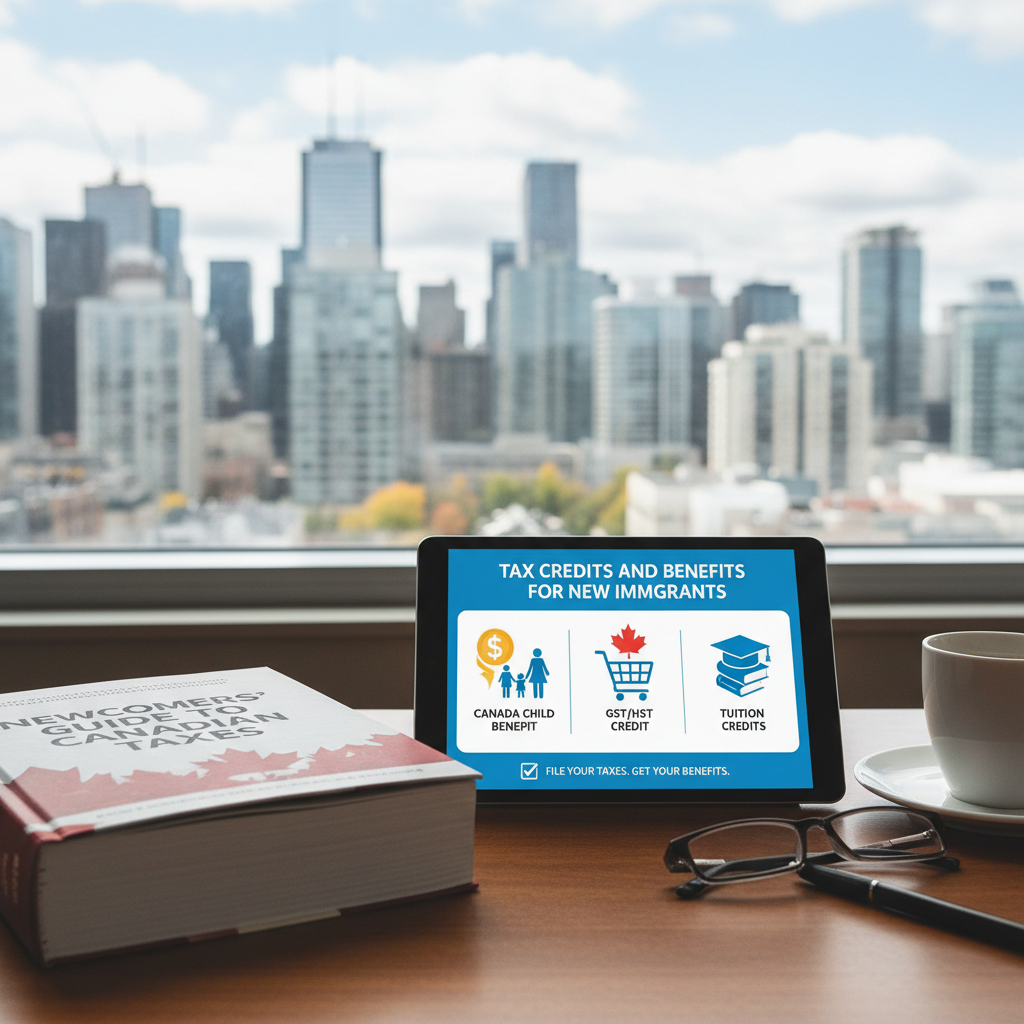
GST/HST Credit, Canada Child Benefit, Tuition and Rent Credits
By filing your taxes, you open the door to several key government benefits.
New immigrants are often eligible for these programs, which provide regular, tax-free credit payments to help with the cost of living.
It is one of the most important reasons to file a return, even if you have no income.
These programs can provide significant financial support to you and your family.
For instance, the Canada Child Benefit (CCB) offers a monthly payment to help with the costs of raising children under 18. Other programs help offset everyday expenses.
Here are some of the most valuable credits and benefits:
- GST/HST Credit: A quarterly payment that helps low- and modest-income individuals and families offset the sales tax they pay.
- Tuition Credits: If you paid for post-secondary education, you can claim these credits to reduce your tax payable. Unused amounts can be carried forward.
- Rent Credits: Depending on your province, you may be able to claim a portion of your rent payments to lower your taxes.
Common Mistakes New Immigrants Make When Filing Taxes
Filing taxes for the first time in a new country can be tricky, and it's easy to make mistakes.
Common errors can lead to a smaller tax refund, delays in receiving benefits, or even penalties from the CRA. Being aware of these pitfalls can help you avoid them.
Some of the most frequent mistakes involve getting your residency status wrong, incorrect income reporting, or overlooking a valuable deduction.
For example, what income do I have to report on my first Canadian tax return as a newcomer?
Getting this wrong is a major red flag. The next sections will detail how to avoid these common errors.

Avoiding Errors with Residency Status and Income Reporting
Two of the most critical areas where newcomers make mistakes are with their residency status and income reporting.
The Canadian tax system is based on residency, so an incorrect determination of residency status can have major consequences.
Remember that your tax residency is based on your residential ties, not your immigration status.
Another common error is with income reporting. As a Canadian resident, you must report your worldwide income earned after your arrival date.
Many newcomers mistakenly only report their Canadian income, which can lead to audits and penalties. It's crucial to include income from all sources.
If you arrived partway through the year, you must correctly prorate certain tax credits based on the number of days you were a resident.
Getting these details right ensures your tax return is accurate and compliant, preventing future issues with the CRA.
Overlooked Deductions, Credits, and Benefits
Many newcomers miss out on a larger tax refund simply because they overlook deductions, credits, and benefits they are entitled to claim.
It's easy to forget about certain expenses when you're focused on reporting your income, but these claims can save you a lot of money.
Filing a tax return is the only way to access valuable government benefits like the GST/HST credit and the Canada Child Benefit.
A common mistake is assuming that if you have no income, you don't need to file. This thinking causes you to miss out on these important payments.
Make sure you claim all eligible expenses. Some frequently overlooked claims include:
- Medical expenses not covered by insurance.
- Childcare expenses paid so you or your spouse could work or go to school.
- Moving expenses, if you moved for a new job. Always keep your receipts and tax slips to support your claims.
Conclusion
Filing taxes in Canada for the first time may seem daunting, but with the right information and support, you can navigate the process confidently.
Understanding your obligations, gathering necessary documents, and recognizing deadlines are essential steps to ensure a smooth experience.
Moreover, being aware of common mistakes can help you avoid unnecessary penalties and maximize your benefits.
Remember, professional assistance can simplify this journey and provide peace of mind as you adapt to the Canadian tax system.
If you have any questions or need further guidance, don’t hesitate to get in touch.
You’re not alone on this journey support is available to help you succeed!
Contact Us today for free consultation
Frequently Asked Questions
Do I need a Social Insurance Number to file taxes in Canada?
Yes, a Social Insurance Number (SIN) is essential for filing your personal income tax return in Canada. This number is your primary identifier for tax purposes and is required to report income and receive benefits. If you don't have a SIN, you should apply for one through Service Canada immediately.
How do I get my Notice of Assessment after filing my first tax return?
After the Canada Revenue Agency processes your tax return, they will send you a Notice of Assessment (NOA). If you file online, you can receive it in your CRA account in around two weeks. For paper returns, it will be mailed to you, which can take up to eight weeks.

